the bass that bernie built
one oscillator. one filter. one envelope — the entire vocabulary of P-funk leads and sheffield industrial. dial it the way bernie worrell did on flash light.
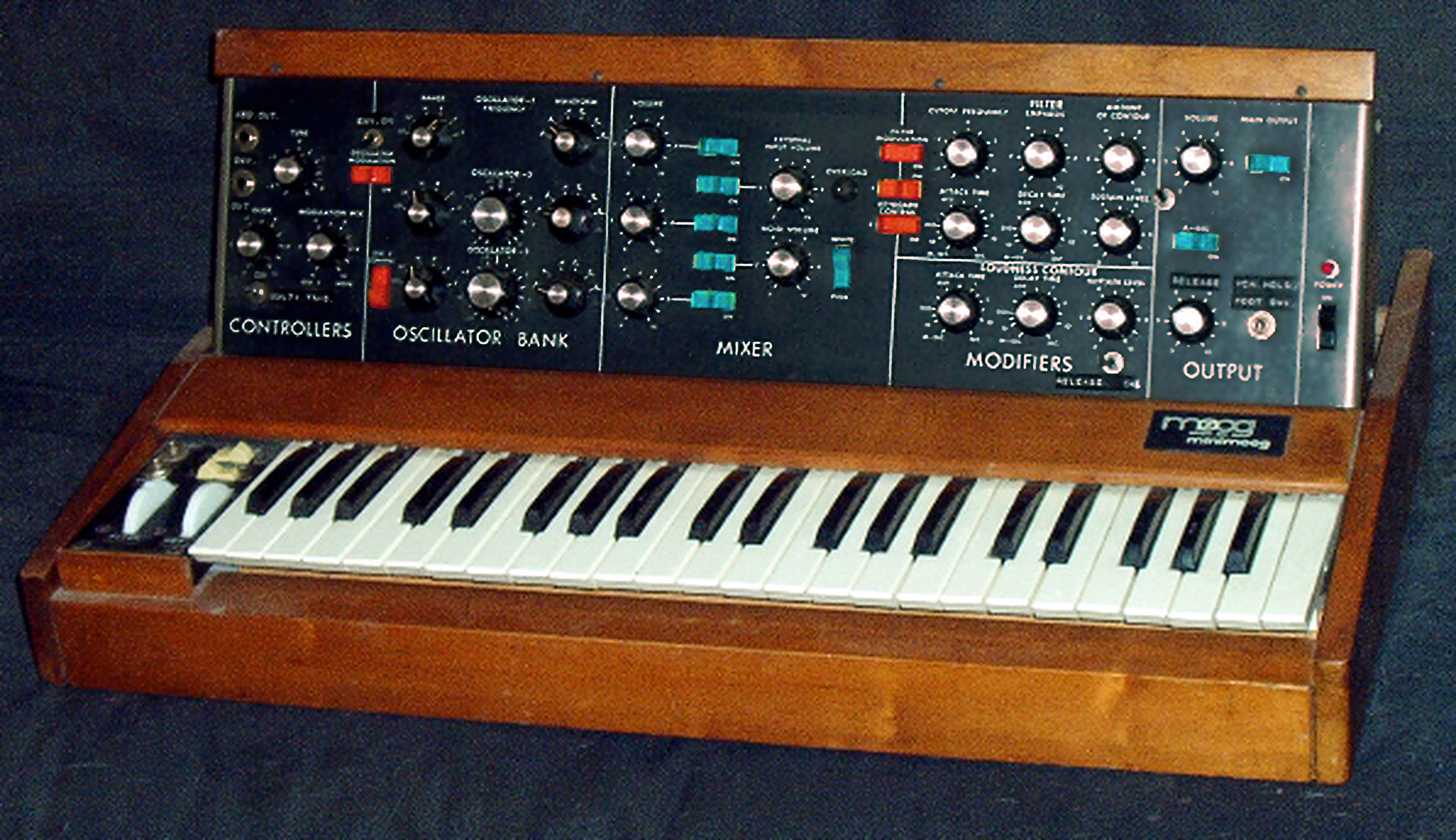
why subtractive is the foundation
bob moog built the first commercial synthesizer in 1964 around an idea that was already old in the analog studios: take a harmonically-rich oscillator, then removethe harmonics you don't want. the moog ladder filter — four stages of opamp lowpass with feedback — was the killer feature. it sounded warm, it self-oscillated at high resonance, and it could be modulated.
bernie worrell met one in the early 70s. as the keys player for parliament- funkadelic, he turned the moog bass into an instrument unto itself — not playing like a bassist with a keyboard, playing like a moog. flash light (1977) is the bass line that retired everyone else: tight square + sub, fast filter envelope, no glide, all funk.
stevie wonder had moogs in his rig from music of my mind(1972) onward. the "songs in the key of life" era is dense with subtractive textures that aren't solos — they're *roles*. stevie's synths sit in the arrangement like horns or like backing vocals.
across the atlantic, sheffield was busy figuring out the opposite use: not warm funk, but cold industrial. cabaret voltaire, the human league, early heaven 17 — same circuits, completely different intent. that lineage runs straight into early detroit techno (juan atkins owned a minimoog) and back through bristol trip-hop.
what to do in this room: load flash-light bass, hold a note, and stab the envelope amount. then drop the cutoff. then push resonance past 70 and hear the filter start to sing. then load cabaret-drone, hold the same note, and feel how the same circuit becomes a completely different instrument.
the people on the machine
the moog wasn't one sound. funk players, prog composers, sheffield weirdos, and a handful of producers who decided to plug the cable into something new.
go listen
the moog bassline that retired all the other bassists. bernie worrell played a square + sub through a fast filter envelope. you can hear the cutoff opening every single note. listen with the patch loaded — that's why it's the default.
stevie's clavinet is upstairs; the synth bass under it is downstairs. tight envelope, square wave. once you hear the difference between the clav and the synth you can't unhear it. (the synth is the one with the perfectly clean attack — no hammer.)
sheffield industrial. same architecture as worrell's bass — saw + lowpass — used for an entirely different purpose. slow attack, long sustain, filter sweeping. the cabaret-drone preset is wired for this.
next on the punch list
- · 2nd + 3rd oscillator (true minimoog stacking)
- · LFO with destination matrix (cutoff / pitch / amp)
- · true 4-pole ladder filter via AudioWorklet (we're cascading biquads for v0)
- · pattern record + MIDI export, plus play-with-the-909 mode
- · WAV export of held notes / sweeps